
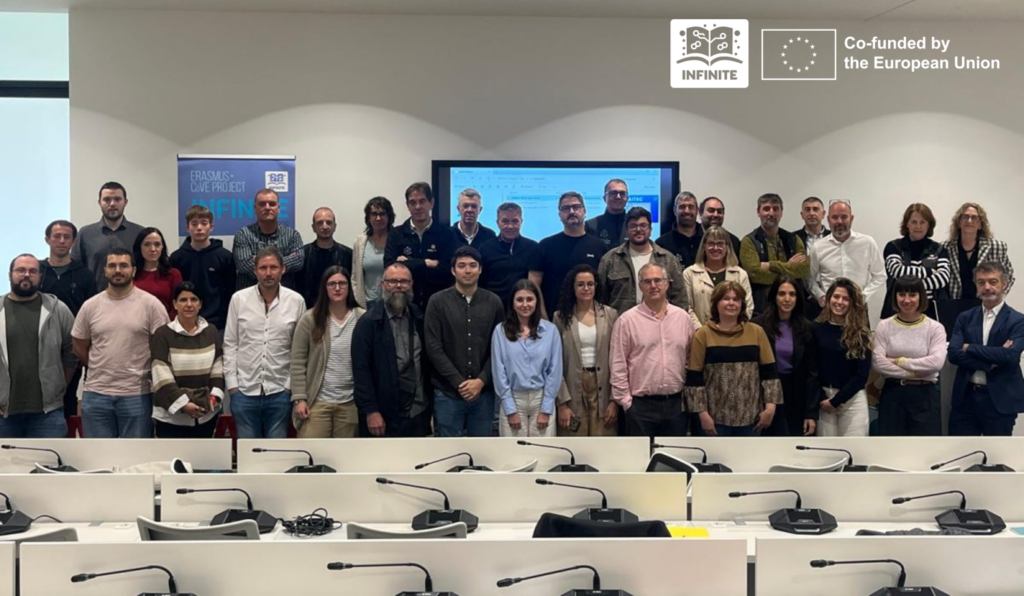
On May 7, Functional Print Cluster held the technical workshop “From Ink to Industrial Process” at Salesianos Pamplona. The session was organized together with Cyclops Synergies, with the collaboration of NAITEC and Plataforma Tecnológica 3NEO, within the European project INFINITE – Intelligent Printing, Flexible and Organic Electronics Excellence.
The event brought together companies, printers, technology centers, training organizations, and professionals from the functional printing and printed electronics ecosystem to explore the strategic role of functional inks and their impact on industrial processes, advanced manufacturing, and printed electronic devices.
From Ink to Industrial Process
During the opening session, Susana Barasoain, Managing Director of Functional Print Cluster and Plataforma 3NEO, highlighted the growth of the European printed electronics market and the increasing demand for specialized professionals (one of the key objectives of the INFINITE project) capable of connecting materials, processes, design, and industrialization.
She also emphasized how functional inks have become strategic advanced materials amid technological evolution, pressure on critical raw materials, and Europe’s transition toward more sustainable and resilient industrial ecosystems.
Applied Technical Knowledge and Industrial Vision
The first part of the workshop was led by Josh Morris, Director of Cyclops Synergies, who presented different types of functional inks (conductive, dielectric, resistive, and anisotropic) together with their properties, printing methods, curing processes, and applications in printed electronics.
Key industrial challenges discussed included conductivity, adhesion, flexibility, environmental stability, and silver migration. The growing importance of adhesive inks and solutions for radiofrequency applications and flexible electronics was also addressed, alongside how formulations and machinery requirements vary depending on the final application.
Later, Dr. Rakel Herrero, Project Manager at NAITEC, focused on the manufacturing and industrialization challenges of printed electronics. Her presentation covered technologies such as screen printing, flexography, gravure, and inkjet, together with sustainable materials and the integration of printed and conventional electronics.
Real industrial applications were showcased, including flexible circuits, RFID technologies, printed heating elements, and advanced functional devices.
A Space for Technical Dialogue and Cross-Sector Networking
One of the most valued aspects of the workshop was the open technical dialogue among participants.
Companies from different parts of the value chain shared experiences, challenges, and practical needs related to ink performance, material selection, scalability, sustainability, electronic integration, and industrial adaptation.
These exchanges encouraged valuable cross-sector learning in functional printing, fostering new connections between industry, technology, and education. Discussions during the networking session also highlighted the growing talent gap linked to emerging hybrid professional profiles in advanced materials, functional printing, and printed electronics.
New Specialization Course in Functional Printing
The workshop was also part of the 2025 training activities developed under the European INFINITE project, following previous sessions held in Pamplona, Bilbao, and Valencia.
To close the event, Salesianos Pamplona presented its new 600-hour Specialization Course in Functional Printing, a pioneering initiative in Spain aimed at connecting vocational training, universities, and industry to address the sector’s real needs.
Functional Print Cluster and Plataforma 3NEO will continue promoting technical activities, sector meetings, and training initiatives in the coming months to strengthen the European ecosystem of functional printing and printed electronics.

Funded by the European Union. Views and opinions expressed are however those of the author(s) only and do not necessarily reflect those of the European Union or the European Education and Culture Executive Agency (EACEA). Neither the European Union nor EACEA can be held responsible for them.